The methodology for designing and structuring a relational database typically requires first designing a conceptual data model that typically consists of the entity and relationship types, attributes and attribute domains, and primary and alternate keys (Connolly & Begg, 2015). This graphical representation is known as the entity-relationship diagram (ERD). To create an effective conceptual model, the needs of the organization must be understood. What data does the organization plan to collect, maintain, and analyze? How does this data relate to that data? How should the data be represented in the database, such as what relations (tables) might there be, what attributes (columns) might there be in those tables, and what should those relations and attributes be titled?
One way to notate the ERD is to use Crow’s Foot Notation, which evolved from Gordon C. Everest’s (1976) inverted arrow. Crow’s Foot Notation is another tool to graphically represent the cardinality and participation between two entities or, in the case of a recursive relationship, one entity with itself.
An example of an ERD with Crow’s Foot Notation and the corresponding data dictionary may be found in Figure 1 and Figure 2, respectively, below. Please see Bookstore Database Project for the deployment of this ERD and data dictionary. The SQL code that was used to create this database in Microsoft SQL Server Management Studio 18 is available there.
Figure 1
ERD with Crow’s Foot Notation
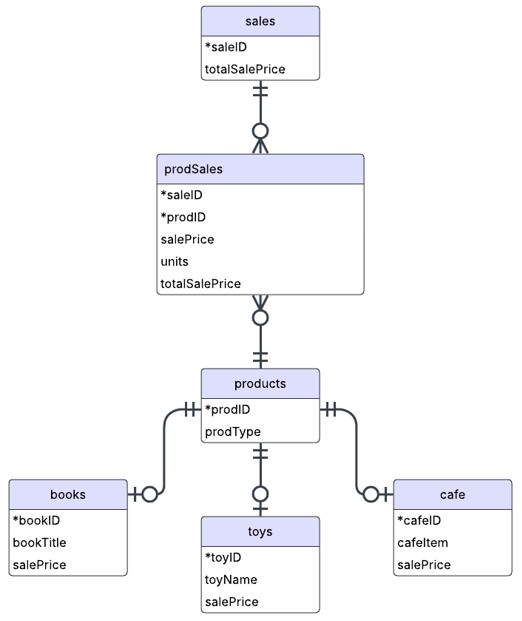
Figure 2
Corresponding Data Dictionary

In this short technical explanation, it would be impractical to attempt to cover to a great extent the variety of ERDs and Crow’s Foot Notation. The interested reader is encouraged to review the references for more information.
References
Connolly, T. M., & Begg, C. E. (2015). Database systems: A practical approach to design, implementation, and management (6th ed.). Pearson.
Everest, G. C. (1976). Basic data structure models explained with a common example. Proceedings Fifth Texas Conference on Computing Systems.
Watson, R. T. (2025). Data management: Databases and data analytics (Open ed.). Richard T. Watson. https://www.richardtwatson.com/open/Reader/_book/
 Daniel M. Packer